Chapter 2
Current, Resistance & DC Circuits
2.1 Current and Ohm’s law
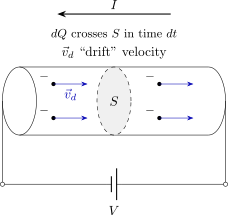
Current: let \(dQ\) be the charge that passes through the surface \(S\) (the wire’s cross-section) in a time \(dt\). Then \[\keyeq{\displaystyle I := \frac{dQ}{dt}}\] measured in amperes, \(\mathrm{A} = \mathrm{C/s}\) (coulombs per second). A voltage source attached across the wire drives the current.
Ohm’s law
Inside a conductor, the electric field drives a current. The local current density \(\vb J\) (current per unit area, in \(\mathrm{A/m^2}\)) is proportional to the field, and the factor of proportionality is the resistivity \(\rho\), a property of the material: \[\vb E = \rho\,\vb J .\] Now consider a uniform wire of length \(L\) and cross-sectional area \(A_S\) (the area of \(S\)), with a voltage \(V\) across its ends. The field is uniform, so \(E = V/L\), and the current density is uniform, so \(I = J\,A_S\). Then \[V = E\,L = \rho\,J\,L = \rho\,\frac{I}{A_S}\,L ,\] that is, \[\begin{equation} \tag{2.1} \keyeq{V = R\,I}, \qquad \keyeq{\displaystyle R = \frac{\rho L}{A_S}}. \end{equation}\] This is Ohm’s law: the voltage across the wire is proportional to the current through it, where the resistance \(R\) is a constant that depends on the electrical (through \(\rho\)) and geometric (\(L\), \(A_S\)) properties of the wire. Resistance is measured in ohms, \(\mathrm{\Omega } = \mathrm{V/A}\).
2.2 Kirchhoff’s rules
1. Junction rule
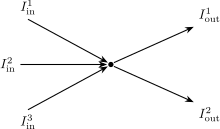
\[\keyeq{\displaystyle \sum_{i=1}^{N} I_{\mathrm{in}}^{i} = \sum_{i=1}^{M} I_{\mathrm{out}}^{i}}\] The total current into a junction equals the total current out. This is conservation of charge.
2. Loop rule
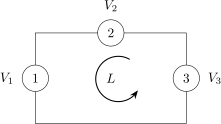
\[\keyeq{\displaystyle \sum_{\text{closed loop}} V_i = 0}\] The voltages around any closed loop sum to zero. This is conservation of energy.
To apply the loop rule:
Choose a loop, with a direction.
Use sign conventions, e.g.:
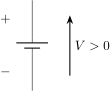
A battery contributes the voltage it induces, \(V>0\) (traversed from its \(-\) to its \(+\) terminal).
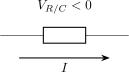
A resistor or capacitor (traversed along the current \(I\)) gives a voltage drop over the component, \(V_{R/C}<0\).
Example (OpenStax Example 10.7)
Find \(I\).
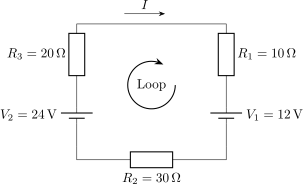
The loop rule (watch the signs!) gives \[V_2 - I R_3 - I R_1 - V_1 - I R_2 = 0 \;\Longrightarrow\; \keyeq{\displaystyle I = \frac{V_2 - V_1}{R_3 + R_2 + R_1} = \frac{12\,\mathrm{V}}{60\,\mathrm{\Omega }} = 0.2\,\mathrm{A}}\]
2.3 Resistors in series and parallel
Series
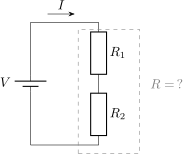
Let \(R\) be the effective resistance of the combination. By the junction rule, the same current flows through both resistors, \(I_1 = I_2 = I\). By the loop rule, \(V = V_1 + V_2\), so by (2.1) \[R = \frac{V}{I} = \frac{R_1 I + R_2 I}{I}\] \[\keyeq{R = R_1 + R_2}\]
Parallel
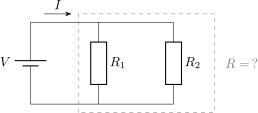
Here the junction rule gives \(I = I_1 + I_2\), and the loop rule gives equal voltages across the two resistors: \[I = I_1 + I_2, \qquad V = V_1 = V_2 .\] By Ohm’s law, \[\frac{V}{R} = \frac{V}{R_1} + \frac{V}{R_2}\]
\[\keyeq{\displaystyle \frac{1}{R} = \frac{1}{R_1} + \frac{1}{R_2}}\]
Example (OpenStax Example 10.4)
Find the equivalent resistance \(R\) of the circuit below.
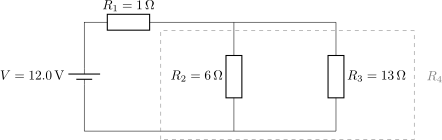
First find \(R_4\), the combination of \(R_2\) and \(R_3\) in parallel: \[\frac{1}{R_4} = \frac{1}{R_2} + \frac{1}{R_3} \;\Longrightarrow\; R_4 = \frac{R_2 R_3}{R_2 + R_3} = \frac{78}{19}\,\mathrm{\Omega }.\] Then \(R_4\) is in series with \(R_1\): \[\keyeq{R = R_1 + R_4 = \left(1 + \dfrac{78}{19}\right)\mathrm{\Omega } = 5.10\,\mathrm{\Omega }}\]
2.4 RC circuits
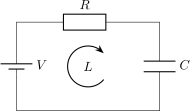
Loop rule around the loop \(L\): \[V - V_R - V_C = 0,\] with \(V_R = IR\) (Ohm’s law) and \(V_C = Q/C\) (capacitance). Hence \(V - IR - Q/C = 0\), and with \(I = dQ/dt\), \[\begin{equation} \tag{2.2} \keyeq{\displaystyle R\,\frac{dQ}{dt} + \frac{1}{C}\,Q = V(t)} \end{equation}\] This is a differential equation for \(Q(t)\).
Charging a capacitor
Take a constant applied voltage and no initial charge: \[V(t) = V, \qquad Q(0) = 0 .\] Then (2.2) reads \(RC\,\dfrac{dQ}{dt} = CV - Q\), i.e. \[\frac{dQ}{CV - Q} = \frac{dt}{RC}.\] Integrating, with the substitution \(u = CV - Q\), \(du = -dQ\): \[\int_0^{Q(t)} \frac{dQ}{CV-Q} = \frac{t}{RC} \quad\Longrightarrow\quad -\int_{CV}^{CV-Q(t)} \frac{du}{u} = \ln\frac{CV}{CV-Q(t)} = \frac{t}{RC}.\] Therefore \(e^{t/RC} = \dfrac{CV}{CV-Q(t)}\), i.e. \[\keyeq{\displaystyle Q(t) = CV\left(1 - e^{-t/RC}\right)}\]
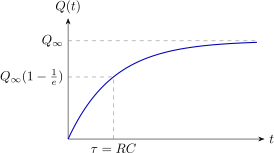
Call \[Q_\infty := CV, \qquad \tau := RC,\] the final charge and the charging/decay time.
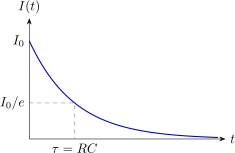
The current is \[\keyeq{\displaystyle I(t) = \frac{dQ}{dt} = \frac{CV}{RC}\,e^{-t/RC} = \frac{V}{R}\,e^{-t/RC}}\] with \(\displaystyle I_0 := \frac{V}{R}\).
Discharging a capacitor
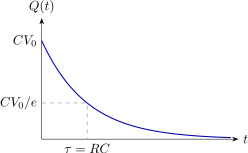
Now remove the source and start from a charged capacitor: \[V(t) = 0, \qquad Q(0) = CV_0 .\] Then (2.2) becomes \[\begin{equation} \tag{2.3} \frac{dQ}{dt} = -\frac{1}{RC}\,Q \quad\Longrightarrow\quad -\frac{dQ}{Q} = \frac{dt}{RC}. \end{equation}\] Integrating, \[-\int_{CV_0}^{Q(t)} \frac{dQ}{Q} = \frac{t}{RC} \quad\Longrightarrow\quad \ln\frac{Q(t)}{CV_0} = -\frac{t}{RC},\] so
\[\keyeq{\displaystyle Q(t) = CV_0\,e^{-t/RC}}\] \[\keyeq{\displaystyle I(t) = \frac{dQ}{dt} = -\frac{V_0}{R}\,e^{-t/RC}}\]
Problems
Problems are taken from the sources listed under Sources and Attribution. Numbers refer to the end-of-chapter problems; figures have been redrawn.
OpenStax University Physics Vol. 2, Chapter 9: Current and Resistance
9.27
The charge on a capacitor in a circuit is modeled as \(Q(t) = Q_{\max}\cos(\omega t + \phi)\). What is the current through the circuit as a function of time?
9.37
What is the resistance of a \(20.0\,\mathrm{m}\)-long piece of 12-gauge copper wire having a \(2.053\,\mathrm{mm}\) diameter?
9.51
A resistor rated at \(250\,\mathrm{k\Omega }\) is connected across two D cell batteries (each \(1.50\,\mathrm{V}\)) in series, with a total voltage of \(3.00\,\mathrm{V}\). The manufacturer advertises that their resistors are within 5% of the rated value. What are the possible minimum current and maximum current through the resistor?
OpenStax University Physics Vol. 2, Chapter 10: Direct-Current Circuits
10.31
Referring to the example combining series and parallel circuits in this lecture (Example 10.4 above), calculate \(I_3\) in the following two different ways: (a) from the known values of \(I\) and \(I_2\); (b) using Ohm’s law for \(R_3\). In both parts, explicitly show how you follow the steps in the problem-solving strategy for series and parallel resistors.
10.39
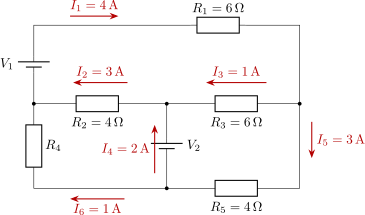
Consider the circuit shown. Find \(V_1\), \(V_2\), and \(R_4\).
10.43
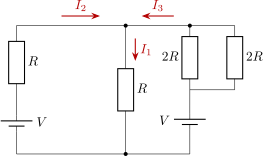
Consider the circuit shown. Write equations for the three currents in terms of \(R\) and \(V\).
10.53
A \(500\,\mathrm{\Omega }\) resistor, an uncharged \(1.50\,\mathrm{\mu F}\) capacitor, and a \(6.16\,\mathrm{V}\) emf are connected in series. (a) What is the initial current? (b) What is the RC time constant? (c) What is the current after one time constant? (d) What is the voltage on the capacitor after one time constant?
10.57
If you wish to take a picture of a bullet traveling at \(500\,\mathrm{m/s}\), then a very brief flash of light produced by an RC discharge through a flash tube can limit blurring. Assuming \(1.00\,\mathrm{mm}\) of motion during one RC constant is acceptable, and given that the flash is driven by a \(600\,\mathrm{\mu F}\) capacitor, what is the resistance in the flash tube?