Chapter 0 Review · Supplementary
Mathematical Preliminaries
This chapter reviews the vector and calculus tools used throughout the course and fixes the notation for vectors, unit vectors and derivatives. Note, this notation might be different than in other math courses you’ve taken, so review this carefully. It is reference material, not a lecture. Work through the review exercises at the end before the first lecture. If any of them feel unfamiliar, come and see me.
0.1 Vectors
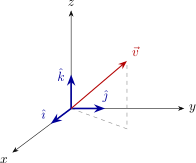
A vector is written with an arrow, \(\vb v\), and is specified by its components along the \(x\), \(y\) and \(z\) axes: \[\begin{equation} \tag{0.1} \keyeq{\vb v = (v_x, v_y, v_z) = v_x\,\uv\imath + v_y\,\uv\jmath + v_z\,\uv k} \end{equation}\] The basis vectors \((\uv\imath, \uv\jmath, \uv k)\) are unit vectors along the three axes. They are linearly independent: none of them can be written as a combination of the other two.
Addition and scalar multiplication
Vectors are added component-wise: \[\vb A + \vb B = (A_x + B_x)\,\uv\imath + (A_y + B_y)\,\uv\jmath + (A_z + B_z)\,\uv k .\] Multiplying by a scalar \(s\) multiplies every component: \[s\vb A = sA_x\,\uv\imath + sA_y\,\uv\jmath + sA_z\,\uv k .\]
The dot product
The basis vectors satisfy \[\uv\imath\cdot\uv\imath = \uv\jmath\cdot\uv\jmath = \uv k\cdot\uv k = 1, \qquad \uv\imath\cdot\uv\jmath = \uv\jmath\cdot\uv k = \uv\imath\cdot\uv k = 0 ,\] so, for general vectors, \[\begin{equation} \tag{0.2} \keyeq{\vb A\cdot\vb B = A_x B_x + A_y B_y + A_z B_z} \end{equation}\] The dot product is a scalar, and it is symmetric: \(\vb A\cdot\vb B = \vb B\cdot\vb A\).
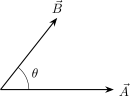
The norm (length) of a vector is \[|\vb A| = A = \sqrt{\vb A\cdot\vb A} = \sqrt{A_x^2 + A_y^2 + A_z^2} .\] In terms of the lengths and the angle \(\theta\) between the two vectors, \[\begin{equation} \tag{0.3} \keyeq{\vb A\cdot\vb B = AB\cos\theta} \end{equation}\] In particular, \(\vb A\cdot\vb B = 0\) when \(\vb A\) and \(\vb B\) are perpendicular.
Unit vectors
A hat denotes a vector of length one. Any non-zero vector \(\vb A\) defines a unit vector in its direction, \[\keyeq{\displaystyle \uv A = \frac{\vb A}{|\vb A|}}\] so that \(\vb A = |\vb A|\,\uv A\): a length times a direction.
The cross product
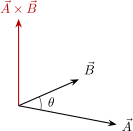
The cross product of two vectors is another vector, most easily remembered as a determinant: \[\vb A\times\vb B = \begin{vmatrix} \uv\imath & \uv\jmath & \uv k \\ A_x & A_y & A_z \\ B_x & B_y & B_z \end{vmatrix} = (A_y B_z - A_z B_y)\,\uv\imath + (A_z B_x - A_x B_z)\,\uv\jmath + (A_x B_y - A_y B_x)\,\uv k .\] It is antisymmetric: \(\vb A\times\vb B = -\,\vb B\times\vb A\).
Its length is \[\begin{equation} \tag{0.4} \keyeq{|\vb A\times\vb B| = AB\sin\theta} \end{equation}\] and its direction is perpendicular to both \(\vb A\) and \(\vb B\), given by the right-hand rule: point the fingers of your right hand along \(\vb A\) and curl them towards \(\vb B\); your thumb points along \(\vb A\times\vb B\).
0.2 Coordinate systems
Polar coordinates
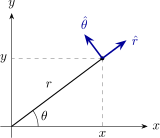
A point \((x,y)\) in the plane can instead be labelled by its distance \(r\) from the origin and the angle \(\theta\) from the \(x\)-axis, \((x,y)\to(r,\theta)\): \[\left\{ \begin{aligned} x &= r\cos\theta \\ y &= r\sin\theta \end{aligned} \right. \qquad \left\{ \begin{aligned} r &= \sqrt{x^2 + y^2} \\ \theta &= \tan^{-1}\!\left(\frac{y}{x}\right) \end{aligned} \right.\] The position vector is \[\vb r = x\,\uv\imath + y\,\uv\jmath = r\,\uv r ,\] where \(\uv r\) points away from the origin and \(\uv\theta\) points in the direction of increasing \(\theta\).
The area element is \[\keyeq{dA = dx\,dy = r\,dr\,d\theta}\]
Cylindrical coordinates
Add \(z\) to polar coordinates: \((x,y,z)\to(r,\theta,z)\), with \(dV = r\,dr\,d\theta\,dz\).
Spherical coordinates
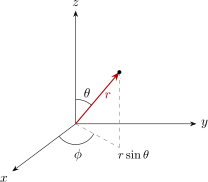
A point in space is labelled by its distance \(r\) from the origin, the angle \(\theta\) from the \(z\)-axis, and the angle \(\phi\) of its projection onto the \(xy\)-plane, measured from the \(x\)-axis: \[\left\{ \begin{aligned} r &= \sqrt{x^2 + y^2 + z^2} \\ \theta &= \tan^{-1}\!\left(\frac{\sqrt{x^2+y^2}}{z}\right) \\ \phi &= \tan^{-1}\!\left(\frac{y}{x}\right) \end{aligned} \right.\]
The projection onto the \(xy\)-plane has length \(r\sin\theta\), so \[\left\{ \begin{aligned} x &= r\sin\theta\cos\phi \\ y &= r\sin\theta\sin\phi \\ z &= r\cos\theta \end{aligned} \right. \qquad\qquad \keyeq{dV = dx\,dy\,dz = r^2\sin\theta\,dr\,d\theta\,d\phi}\]
0.3 Derivatives
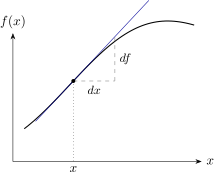
The derivative of \(f(x)\) is \[\begin{equation} \tag{0.5} \keyeq{\displaystyle f'(x) = \frac{df}{dx} = \lim_{\Delta x\to 0}\frac{f(x+\Delta x) - f(x)}{\Delta x}} \end{equation}\] Geometrically, it is the slope of the tangent to the graph of \(f\) at \(x\).
Notation
A prime denotes a derivative with respect to \(x\), and a dot a derivative with respect to time \(t\): \[\keyeq{\displaystyle \frac{df}{dx} = f' , \qquad \frac{dx}{dt} = \dot x , \qquad \frac{d^2x}{dt^2} = \ddot x}\]
Standard derivatives
The power rule: \[\frac{d}{dx}\,x^n = n\,x^{n-1} .\]
Sine and cosine: \[\frac{d}{dx}\sin x = \cos x , \qquad \frac{d}{dx}\cos x = -\sin x .\]
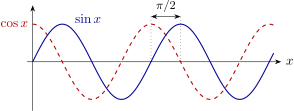
Since \(\cos x = \sin\!\left(x + \frac{\pi}{2}\right)\), differentiating a sine or a cosine shifts it to the left by a quarter period: \[\keyeq{\dfrac{d}{dx} \;\Longleftrightarrow\; \dfrac{\pi}{2}\ \text{phase shift}}\]
The product rule: \[\frac{d}{dx}(fg) = f'g + fg' .\]
The chain rule: \[\keyeq{\displaystyle \frac{d}{dx}\,f\big(g(x)\big) = \frac{dg}{dx}\,\frac{df}{dg}}\]
Example: \(\tan x\)
Write \(\tan x = \sin x\cdot\dfrac{1}{\cos x}\) and use the product rule, then the chain rule for \(1/\cos x\): \[\frac{d}{dx}\tan x = \frac{\cos x}{\cos x} + \sin x\,\frac{d}{dx}\!\left(\frac{1}{\cos x}\right) = 1 + \sin x\cdot\frac{\sin x}{\cos^2 x} = 1 + \tan^2 x .\] Since \(1 + \tan^2 x = \dfrac{\cos^2 x + \sin^2 x}{\cos^2 x} = \dfrac{1}{\cos^2 x}\), \[\frac{d}{dx}\tan x = 1 + \tan^2 x = \sec^2 x .\] The derivatives of the other trigonometric functions follow in the same way.
Exponentials and logarithms
\[\keyeq{\displaystyle \frac{d}{dx}\,e^x = e^x} \qquad\qquad \keyeq{\displaystyle \frac{d}{dx}\ln x = \frac{1}{x}}\] Together with the rules above, these are all you need. For example, writing \(a^x = e^{x\ln a}\) and using the chain rule, \[\frac{d}{dx}\,a^x = \frac{d}{dx}\,e^{x\ln a} = \ln a\; e^{x\ln a} = a^x\ln a .\]
0.4 Integrals
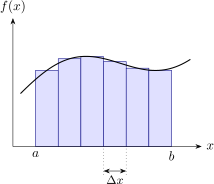
The integral of \(f(x)\) from \(a\) to \(b\) is the area under its graph. Cut \([a,b]\) into \(N\) strips of width \(\Delta x = (b-a)/N\) and add up the areas of the rectangles: \[\begin{equation} \tag{0.6} \keyeq{\displaystyle \int_a^b f(x)\,dx = \lim_{N\to\infty}\sum_{i=1}^{N} f(x_i)\,\Delta x} \end{equation}\] where \(x_i\) is a point in the \(i\)-th strip.
The area is signed: where \(f(x) < 0\), the rectangles count negatively.
The fundamental theorem of calculus
A function \(F\) is an antiderivative of \(f\) if \(F' = f\). The indefinite integral is the most general antiderivative, \[\int f(x)\,dx = F(x) + C ,\] with an arbitrary constant \(C\) (its derivative is zero). The fundamental theorem of calculus says that integration undoes differentiation: \[\begin{equation} \tag{0.7} \keyeq{\displaystyle \int_a^b f(x)\,dx = \Big[F(x)\Big]_a^b = F(b) - F(a)} \end{equation}\] So every derivative you know, read backwards, gives an integral.
Polynomials
Reading the power rule backwards, \[\keyeq{\displaystyle \int x^n\,dx = \frac{x^{n+1}}{n+1} + C} \qquad (n \neq -1), \qquad\qquad \int \frac{dx}{x} = \ln|x| + C .\] Integrals are linear, so a polynomial is integrated term by term. For example, \[\int_0^2 \left(3x^2 - 2x + 1\right)dx = \Big[x^3 - x^2 + x\Big]_0^2 = (8 - 4 + 2) - 0 = 6 .\]
Sine and cosine
Reading the derivatives of sine and cosine backwards, \[\keyeq{\displaystyle \int \sin x\,dx = -\cos x + C} \qquad\qquad \keyeq{\displaystyle \int \cos x\,dx = \sin x + C}\] For example, over half a period \[\int_0^\pi \sin x\,dx = \Big[-\cos x\Big]_0^\pi = -(-1) - (-1) = 2 ,\] but over a full period the positive and negative areas cancel: \[\int_0^{2\pi} \sin x\,dx = \Big[-\cos x\Big]_0^{2\pi} = -1 - (-1) = 0 .\] When the argument is \(\omega t\), the chain rule brings out a factor of \(\omega\), which the integral must divide back out: \[\int \cos(\omega t)\,dt = \frac{1}{\omega}\sin(\omega t) + C , \qquad \int \sin(\omega t)\,dt = -\frac{1}{\omega}\cos(\omega t) + C .\] Check by differentiating!
Problems
Problems are taken from the sources listed under Sources and Attribution. Numbers refer to the end-of-chapter problems; figures have been redrawn.
OpenStax Calculus Vol. 3, Chapter 2: Vectors in Space
2.427
Use the given vectors to find the quantities: \(\vb a = 9\,\uv\imath - 2\,\uv\jmath\), \(\vb b = -3\,\uv\imath + \uv\jmath\). (a) \(3\vb a + \vb b\); (b) \(|\vb a|\); (c) \(\vb a\times|\vb b\times\vb c|\); (d) \(\vb b\cdot\vb a\).
2.429
Find the values of \(a\) such that the vectors \((2, 4, a)\) and \((0, -1, a)\) are orthogonal.
2.443
Convert the given equation from cylindrical coordinates to rectangular coordinates. Identify the given surface. \[r^2 - 2r\cos\theta + z^2 = 1\]
2.445
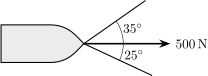
A small boat is crossing a river. When the boat reaches the shore, two ropes are thrown to people to help pull the boat ashore. One rope is at an angle of \(25^\circ\) and the other is at \(35^\circ\). If the boat must be pulled straight and at a force of \(500\,\mathrm{N}\), find the magnitude of force for each rope (see the figure).
OpenStax Calculus Vol. 1, Chapter 3: Derivatives
Find the derivatives of the following functions.
3.373
\(f(x) = 3x^3 - \dfrac{4}{x^2}\)
3.375
\(f(x) = e^{\sin x}\)
3.377
\(f(x) = x^2\cos x + x\tan(x)\)
3.381
First derivative of \(y = x\ln(x)\cos x\).
OpenStax Calculus Vol. 1, Chapter 5: Integration
5.447
Evaluate the integral \(\displaystyle \int_{-1}^{1}\left(x^3 - 2x^2 + 4x\right)dx\).
5.449
Evaluate the integral \(\displaystyle \int_{\pi/3}^{\pi/2} 2\sec(2\theta)\tan(2\theta)\,d\theta\).
5.451
Find the antiderivative \(\displaystyle \int \frac{dx}{(x+4)^3}\).